
The article I read this week was about
the importance of print referencing during read-alouds. The main
goal of print referencing is to “engage emergent readers in
conversations about print that foster one's ability to consider
language an object of attention,” (Zucker,
Ward, & Justice, L. M 2009
pg 63). Writing and reading go hand in hand, as you
read aloud text in the classroom, you model how a writer and an
illustrator made a book using several pages linked together. Imagine
that, connecting pictures and words together one page at a time to
create an entire story! It is a concept that we sometimes take for
granted, but what a new world for children! Selecting text properly
is a large component of emergent writing. While reading, talking to
determine a text's purpose solidifies the child's thoughts and
opinions, allowing them to be involved while you as a teacher are
guiding them(Fountas
& Pinnell, 2011, pg 157).
Specific teacher language is highly supportive of young writers as
they expand their knowledge(Fountas
& Pinnell, 2011,pg 169).
Linking a child's prior knowledge to the new information that is
being presented is essential, so what do you say to the child then
exactly? The text also goes on to explain that you cannot plan
exactly what you will say when you have a conference with a young
writer, but you can research suggestions and customize them to
accommodate the student you are working with. Tapping into
experience during interactive writing helps to integrate a new skill
from an already strong interest in the child, so it is not something
you can plan for ahead of time as far as a script, but being informed
of the types of questions to ask is essential.
Written words are forever! Well,
almost, constructing the written message allows the words that you
have worked on together become concrete. Children are able to
reread, slowing down the processing therefore making it easier to
focus on the details. Building gradually and slowly is key to
identifying and constructing the sound and structure of letters.
Rereading also reinforces the letter and sound concepts, and is used
to allow authors to come up with new ideas as what to write
next(Fountas
& Pinnell, 2011, pg 158).
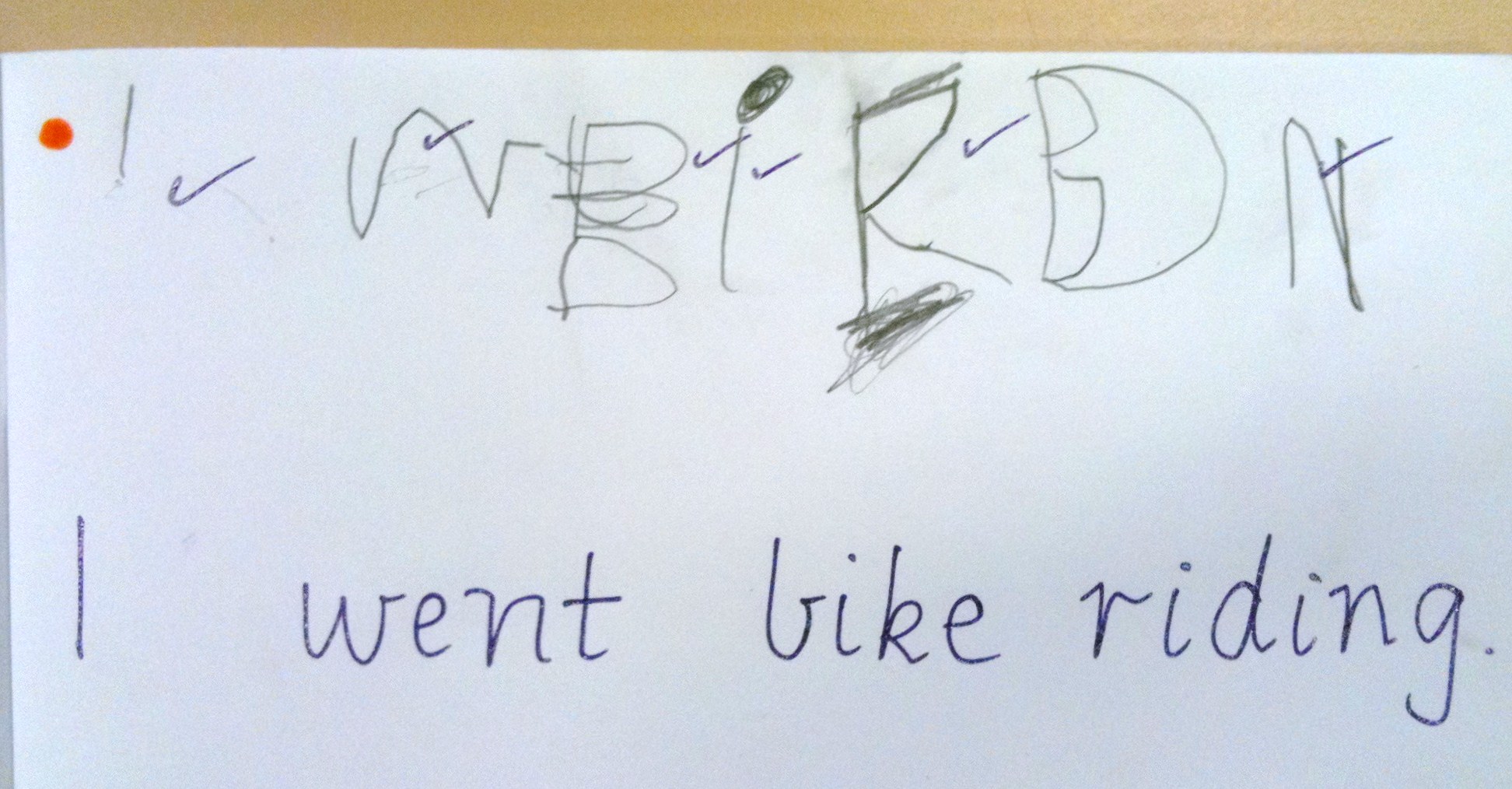
A beautiful and concise definition of
responsive teaching in the text on page 167, “Pose problems, ask
questions, and make comments and suggestions that stimulate
children's thinking and extend their learning.” Most importantly
the base skill of emergent writing comes down to teacher-child
interaction, we need to be a model to our students and exhibit proper
techniques to scaffold this imperative skill.
References
North
East Florida Educational Consortium. Emergent Writing-- Video
Accessed: June 25, 2017
Pinnell,
G. S., & Fountas, I. C. (2011). Literacy
beginnings: a prekindergarten handbook.
Portsmouth, NH: Heinemann.
Zucker,
T. A., Ward, A. E., & Justice, L. M. (2009). Print Referencing
During Read-Alouds: A Technique for Increasing Emergent Readers Print
Knowledge. The
Reading Teacher, 63(1),
62-72. doi:10.1598/rt.63.1.6

Hi Brigid!
ReplyDeleteWhen I first read about what Module 4 was going to be about, I (wrongfully) assumed I wasn’t going to be able to relate because I teach fourth grade. However, after reading I realized that while my students are older, most of them are also ELL students, so they are learning to read and write the English language. Over the years I have certainly learned that while they have some background in writing, it sometimes feels like they are writing for the first time.
The first similarity between our articles was that any mark on paper conveys a meaning! It is absolutely amazing that even as a young child that appears to just be scribbling is actually trying to convey a message. It may not be a message we can comprehend or recognize, but to them it IS something. Our articles also both emphasize the importance of shared and/or interactive writing. It is so important for the teacher to act as a guide/model to the student and allow them to practice.
I also like that you mention linking a students to prior knowledge to the new information, this was also something that my article referenced in directly. By using classic stories, the children all already knew the story and were able to talk about and discuss it before beginning to rewrite their own. I think this makes a huge difference for students and allows them to connect better to the story. By letting them rewrite enabled them to bring in their own ideas and even their culture to make something completely new.
One thing that my article did not mention was print referencing. My article was about a project that two teachers spearheaded that involved students reading classic stories and then rewriting their own version of it. I have never heard of print referencing so it was interesting to read about. Print referencing seems to differ from my article in that it focuses on conversations with students about how words and images created a story. In my article the students took it one step further and were able to actually act as authors themselves and use what they know and put it to the test.
Thank you for sharing!
Gina
Hi Brigid! As I read through your blog I saw that your article references book making. This is what my article was all about. In the article that I read, second grade students took the story of Goldilocks and the Three Bears and changed it to best fit their own culture using modern technology. The teachers had to go in depth to teach the students the background of the story and get them to really understand the story before they could write their own. No matter what grade a child is in, I think creating a book of their own is great accomplishment. It allows them to express their thoughts and ideas through drawings and any of the phases of writing. I also think this would be a great idea for teachers to do in their classrooms. You could even take it a step further and make it a school wide thing. It would be really interesting to see the similarities and differences between a kindergartner's book and a fifth graders book.
ReplyDeleteOne thing that I noticed that was different about our articles was that your article focuses more on print referencing. I think it is really beneficial for students to have a teacher that is going to use this concept of print referencing in their classroom. Allowing children the opportunity to learn and talk about print is only going to help them with their writing as time goes on. Once children have this foundation of knowing that pictures and words make a story, then they will be able to take these skills and use it to create a book of their own.
As educators we need to make sure we are using all of the necessary tools we have been given to help our students grow academically.
Hi Brigid,
ReplyDeleteI read the first article which outlines the four stages of emergent writing. As you mentioned when writing about your article it is crucial to have a great deal of support from the teacher when children begin to start writing. In my article, there was a very informative chart included which goes over each early writing stage and strategies that teachers can use throughout different parts of the day such as message time, work centers, and journal writing in order to move them to the next writing stage. The chart also provides goals for those students to meet in order to move to the following stage of emergent writing. For example, if children are at the first stage of their writing called scribbling and drawing, teachers should try to have these students work towards distinguishing writing as separate from writing or to expand the ability to write their name from initial letter to their complete name, to name a couple of goals.
As mentioned earlier, this article also provides teachers with strategies that they can utilize throughout the school day such as setting up sign-in sheets for high-traffic areas, ask children to sign their work while praising them for any forms of writing, scribbling included. Your article seemed to provide a lot of strategies for teachers to use in order to make students aware of print that can be found all around them.
Unlike in your article, Cabell, Gerde and Tortorelli stressed the importance of how getting students to begin writing early will essentially help them along the road with other literacy skills. According to these authors, "early writing is a part of a set of important foundational literacy skills that as necessary precursors to conventional reading" (Cabell, Gerde & Tortorelli, p. 651). Overall, it was interesting to put the pieces from both our puzzles together to get a better picture of how important it is for teachers to support emergent writers.