Saturday, July 8, 2017

Early Literacy Lessons are Continuous & Early Intervention is Key


This week we are looking at assessment in early childhood education, I read two articles that take very different approaches to assessment. The article “Using literacy assessment results to improve teaching for English-language learners,” focuses on using data from the Phonological Awareness Literacy Screening standardized assessment. The results of this test focused on the performance of English-language learners from Spanish-speaking backgrounds to better understand the literacy behaviors of these students. The goal of the results from this assessment is to focus on what kind of instruction might best support students in their learning to read in a new language(Helman, pg 668).

Meanwhile, another hands on approach is introduced in “Tile Test: A hands-on approach for assessing phonies in the early grades.” It describes assessing in a strategic manner, where in an ideal setting you can sit with individual students and engage in a conversation designed to reveal a picture of what the student knows and can do. Areas tested in the first segment include identification of letters' names and sounds, decoding and spelling of monosyllabic words and sight-word reading(Norman and Calfee pg. 42). An interesting part about this technique is training for this type of assessment is not particularly lengthy, it is conducted in a few minutes and there are online references to constantly reference.

That being said there are common themes that tie these two types of assessment together.

Early Literacy Assessments are Continuous

“Ongoing assessment of early literacy progress is essential for giving teachers the information they need to measure student progress, identify students who may require additional or individualized assistance, and guide instructional practice(Helman, pg 668)."  There are three measures to begin the screening process of all students, they must be assessed again in more basic concepts if they do not meet the requirements. That being said the students that are not meeting the benchmark can be again tested on the same concepts after intervention to see how they perform again. Therefore, the ability to compare the data will show the student's progress.

“The Tile Test can be used to collect information before, during, and after instruction to check students' prior knowledge and progress and to plan for future instruction(Norma and Calfee pg 50)."  The article goes on to explain the different options and adaptations for the tile test; to go from individual assessment, to then small group and eventually adapting to a whole class model. This particular model is designed for the teacher to be able to customize the particular area that needs assessment; which again will provide data for comparison.

Early Intervention is Key

The PALS article discussed the importance of a good literacy foundation in order to support the student and keep them at an even pace, preventing a phenomena of the “Matthew Effect-in which the literacy rich keep getting better and the poor advance at a slower rate-can have serious consequences for the literacy progress of English learners(Helman, pg 675).  This is a huge problem facing our schools today, and the sooner an issue is discovered the better off an ELL learner is.


“The Tile Test provides teachers with an efficient and effective tool for assessing young students' understanding of the English orthographic system. Their problem-solving strategies and awareness of strategy use when decoding and spelling new or unfamiliar words surface through the metaphonic discussions(Norman and Calfee, pg 51)."  Awareness of a child's issues and where their literacy skills lye is key to fix an issue before it becomes a bigger problem, without a solid foundation literacy growth is impossible and children, many ELL will get left behind their native English-language speaking peers.

The literacy assessment article focuses on the PALS multi-layered assessment which measures word recognition in isolation, developmental spelling, and oral reading in context. If students do not meet the benchmark they are assessed in letter knowledge, phonemic awareness and concept of word. The Tile test is student focused, taking time with each individual child in order to assess early readers' and writers' understanding of letters, sounds, words, and sentences. The assessments are searching for comprehension in the same areas, however they are interacting with different populations, the PALS assessment study compares the English-only students in comparison to Spanish-speaking only students. Meanwhile the “Tile Test” study did not reference any particular populations. I think that the PALS assessment may be useful as a screening tool for students in order to see on a wider scale where the students fall in comparison to their English-only peers, teachers can use the results in order to focuses their teaching goals and form instructional groups. However perhaps rather then continuing on the second level of the PALS assessment that a combination would be a great tool to utilize. For example to integrate a Tile Test after the first layer of assessment would give teachers the interaction that is missing during the PALS assessment.

Helman, L. A. (2005). Using Literacy Assessment Results to Improve Teaching for English-Language Learners. The Reading Teacher, 58(7), 668-677. 


Norman, K. A., & Calfee, R. C. (2004). Tile Test: A Hands-on Approach for Assessing Phonics in the Early Grades. The Reading Teacher, 58(1), 42-52. 

Friday, June 30, 2017

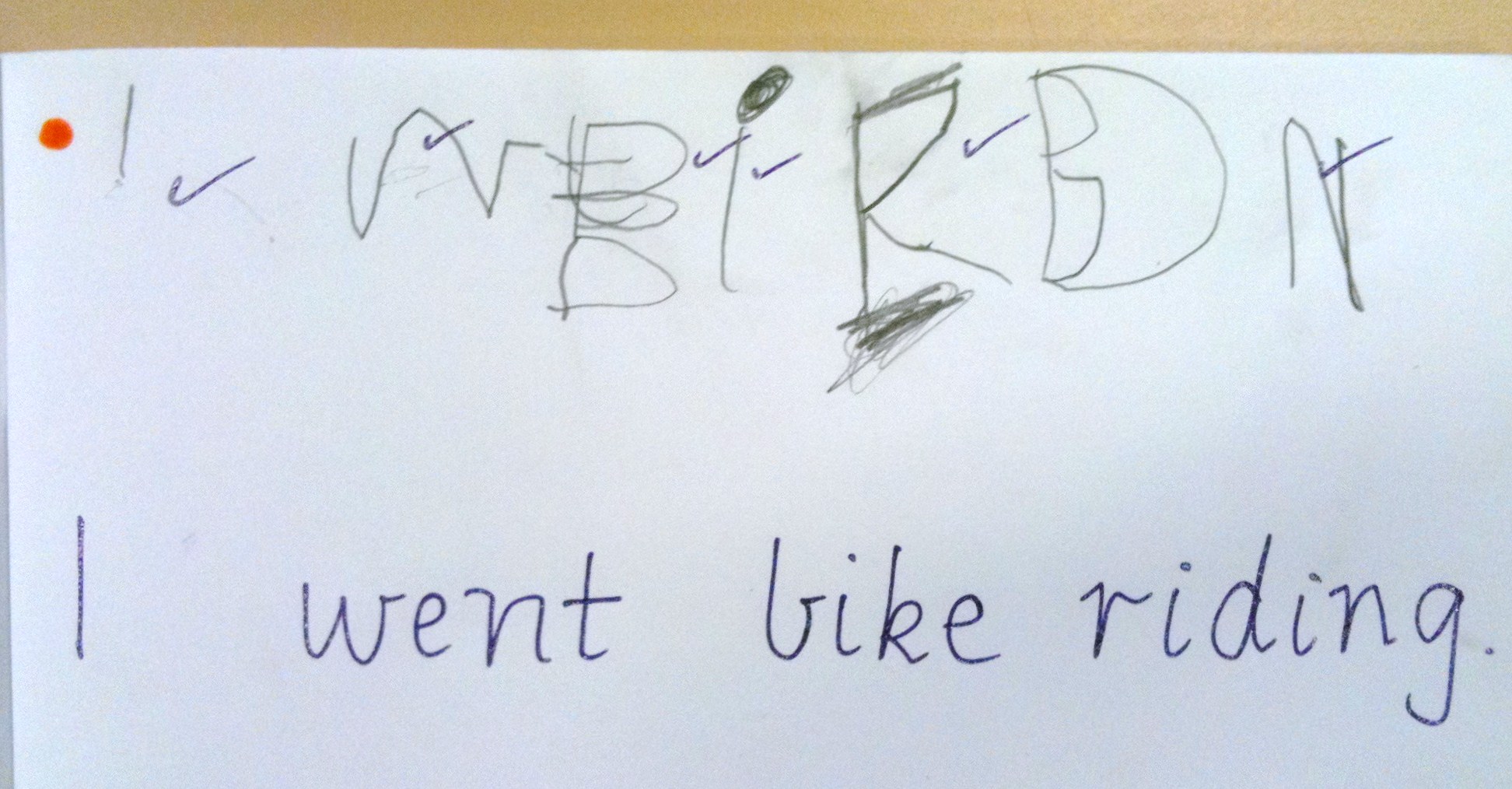
Emergent Writing!


This week we are covering “emergent writing.” Teaching students how to write is a monumental milestone for a child, teacher and parent! It is so exciting to see those first marks on paper that are the beginnings of writing, but where do we go from there? The most important point that the video emphasizes to introduce emergent writing is that print conveys meaning! The first stages are scribble to adults but mean something to children, it is our job as educators to ask questions and scaffold print writing instruction to introduce proper writing. We need to actively involve the children in the writing, asking for ideas and allow the children to express themselves. One on one shared writing with a student can grow into small group shared writing, and eventually evolved into whole group writing. This gradual process of shared and interactive writing can provide powerful demonstration of how the writing process works (Fountas & Pinnell, 2011, pg 169). The guided writing technique involves child's thoughts and gives their ideas validation when the teacher is working hand in hand. Practice is key, so it is important to scaffold instruction promoting independent writing throughout the day.

The article I read this week was about the importance of print referencing during read-alouds. The main goal of print referencing is to “engage emergent readers in conversations about print that foster one's ability to consider language an object of attention,” (Zucker, Ward, & Justice, L. M 2009 pg 63). Writing and reading go hand in hand, as you read aloud text in the classroom, you model how a writer and an illustrator made a book using several pages linked together. Imagine that, connecting pictures and words together one page at a time to create an entire story! It is a concept that we sometimes take for granted, but what a new world for children! Selecting text properly is a large component of emergent writing. While reading, talking to determine a text's purpose solidifies the child's thoughts and opinions, allowing them to be involved while you as a teacher are guiding them(Fountas & Pinnell, 2011, pg 157). Specific teacher language is highly supportive of young writers as they expand their knowledge(Fountas & Pinnell, 2011,pg 169). Linking a child's prior knowledge to the new information that is being presented is essential, so what do you say to the child then exactly? The text also goes on to explain that you cannot plan exactly what you will say when you have a conference with a young writer, but you can research suggestions and customize them to accommodate the student you are working with. Tapping into experience during interactive writing helps to integrate a new skill from an already strong interest in the child, so it is not something you can plan for ahead of time as far as a script, but being informed of the types of questions to ask is essential.

Written words are forever! Well, almost, constructing the written message allows the words that you have worked on together become concrete. Children are able to reread, slowing down the processing therefore making it easier to focus on the details. Building gradually and slowly is key to identifying and constructing the sound and structure of letters. Rereading also reinforces the letter and sound concepts, and is used to allow authors to come up with new ideas as what to write next(Fountas & Pinnell, 2011, pg 158).
Image result for emergent writing examples


A beautiful and concise definition of responsive teaching in the text on page 167, “Pose problems, ask questions, and make comments and suggestions that stimulate children's thinking and extend their learning.” Most importantly the base skill of emergent writing comes down to teacher-child interaction, we need to be a model to our students and exhibit proper techniques to scaffold this imperative skill.  

References 

North East Florida Educational Consortium. Emergent Writing-- Video Accessed: June 25, 2017

Pinnell, G. S., & Fountas, I. C. (2011). Literacy beginnings: a prekindergarten handbook. Portsmouth, NH: Heinemann.

Zucker, T. A., Ward, A. E., & Justice, L. M. (2009). Print Referencing During Read-Alouds: A Technique for Increasing Emergent Readers Print Knowledge. The Reading Teacher, 63(1), 62-72. doi:10.1598/rt.63.1.6

Sunday, June 25, 2017

Module 3

Image result for three little pigs craft

Orlando is a active happy child who has struggled with comprehension while reading independently, causing his teacher to be concerned. A reading specialist was brought in to do a consultation and some strategies were discussed to help Orlando succeed. To be clear, comprehension is the understanding of what has been read and predicting, summarizing, retelling and finally rereading are tried and true comprehension strategies. To help Orlando with his ability to predict, the teacher would find it useful to read favorite stories several times, after the first two or three times reading children are better able to make true predictions since they already know what will happen next(Pinnell, G. S., & Fountas, I. C. 2011 pg. 141). The goal of summarizing at the early level is for students to identify the main idea of the story (Pinnell, G. S., & Fountas, I. C. 2011 pg 138). After reading a book it may be useful to have Orlando look at the pictures in order to recall the important details of the story. Retelling is where he can be creative and recreate the story after it is told, using puppets to create a puppet show or even having a dramatic retelling where he can reenact the dialogue with the teacher as the narrator. Rereading is most frequently the “look back” strategy, to search for answers to questions about the story(Pinnell, G. S., & Fountas, I. C. 2011, pg 122). Reading for fluency is also another rereading strategy; to reread a sentence or paragraph if they had difficulty with a few words, it brings about fluency which is imperative to comprehension(IRIS Center, pg 13). When reading the teacher could give Orlando the opportunity to try out the language in the text, asking him to repeat a sentence or phrase that frequently occurs in the book.

Graphic Organizers are simple diagrams used to assist students in organizing and recalling elements from stories they have listened to or read. They can use simple maps to identify the who, what, where , when and why of a story or sequence the events of a story. Orlando enjoys drawing and this technique has been proven to improve comprehension as well. This is a tool that he can eventually use on his own and to create a mental picture of the story. Markers can be visually seen with the beginning, middle, and end. The story elements can be identified and Orlando will be able to retell the story(IRIS Center, pg 15).

Displaying IMG_2768.JPG

Repeated reading has been shown to assist students with reading comprehension. Partner reading is a form of peer tutoring that should be on the reading level of the less fluent reader. The higher level reader reads a passage first to act as the model, the less fluent reader then reads the passage with help from the partner as needed. Group repeated reading begins with the teacher reading the passage while students follow along in their books. Next, students echo each sentence or paragraph that the teacher reads. Finally the teacher and the students read the passage together. Once the full passage is read as a group, the students can continue to practice the passage during partner reading or independent practice. The group reading strategy would prove to be the best for Orlando since it incorporates his teacher that he is found of and is reinforced in a partner activity that he will enjoy(IRIS Center, pg 29). Reader's theater can implement repeated reading so Orlando may be able to perform for the rest of the class. Furthermore, for many books you can sing the songs together or add body, hand or finger movements (pg 122) all things which would stimulate Orlando, improving his comprehension.


All of these strategies have been effective in improving comprehension, it is just a matter of the individual child's personal preference to see what would work best for him or her! In Orlando's case I firmly believe knowing what I know as an educator that the reader's theater would be enormously beneficial for him since it is fun! It is difficult to struggle and focus at any age and can be very discouraging for a child to be forced into techniques that can be tedious so making learning fun is crucial for the children and the teachers!
Image result for learning is fun
References

A. (2012, April 27). The Three Little Pigs. Retrieved June 24, 2017, from https://www.youtube.com/watch?v=Dxkx9FHpuzk&t=2s

Welcome to the IRIS Center. (n.d.). Retrieved June 21, 2017, from https://iris.peabody.vanderbilt.edu/


Pinnell, G. S., & Fountas, I. C. (2011). Literacy beginnings: a prekindergarten handbook. Portsmouth, NH: Heinemann.

Sunday, June 11, 2017

      The article “Building Preschool Children's Language and Literacy One Storybook at a Time”, introduces reality of preschool and I could relate heavily to almost every word in it. The low wages make living off of one full time job financially stressful. Another huge problem facing this field is the high turnover rate which I can attest to. The preschool class is frequently a temporary position for teachers who are in the process of earning their degrees and certificates to teach in an elementary setting. For me, it was a middle ground which propelled me into pursuing education. While I was working at “The Goddard School” I often times felt as though there were high expectations and low necessary resources. I frequently used money out of my own pocket in order to decorate the classroom and provide materials the students needed to complete the engaging activities I had planned. The lack of professional development available and opportunity for growth often causes teachers to move to older ages or to different careers entirely. Not to mention the fact that it is stressful emotionally, since teachers in this age group are so intimately involved in their student's lives and development. Having said all of that I firmly believe that the children in the end are the reason why I stayed in that job for as long as I did on a day to day basis I truly enjoyed my job, I had the opportunity to smile everyday I walked into work.

     The brain development occurs rapidly at this age which is why language attainments are critical. There are multiple factors that the article focuses on in which shared storybook reading is essential in properly developing. It is the vehicle for language and literacy instruction that already exists typically in the preschool day, it is teacher guided and child focused. The article introduces CBAM which stands for Concerns-Based Adoption Model (pg 27, Beauchat, K. A., Blamey, K. L., & Walpole, S. (2009 ). CBAM researchers assume that as a new practice is introduced, individuals tend to focus on the new practice to be enacted. The findings are measured using Innovation Configuration which identifies the components of practice and implementation techniques and their effectiveness. These specific practices are associated with improved achievement.
Image result for tabby tiger book

     In this particular study the book, “Tabby Tiger” was used to execute CBAM practices and was studied across 15 classrooms. Oral language development is the first skill mentioned that is achieved by hearing sophisticated comments that children can relate to their prior knowledge. Giving examples can propel their own language development, asking open ended questions and prompting questions to expand children's explanations can help do this as well(pg 28, Beauchat, K. A., Blamey, K. L., & Walpole, S. (2009 ).
 
   Next comes comprehension development which can be targeted when teachers ask children questions before, during and after reading(pg 28, Beauchat, K. A., Blamey, K. L., & Walpole, S. (2009 ). By using this method of questions in different parts of the story teachers are helping students develop oral language and language that is about text meaning. Questions asked in the beginning of the story could include prior knowledge, questions in the middle of the story could require children to recall information from earlier in the book, and questions at the end of the story should connect the book all together.

     Building a child's vocabulary is easily achieved when teaching words explicitly. For example, pointing to pictures while reading the text or asking the child to point out the word that was just read. These concrete examples connect the word with a picture or physical concept of the meaning(pg 28-32, Beauchat, K. A., Blamey, K. L., & Walpole, S. (2009 ). Teachers can also target phonological awareness during and after reading, the key is to focus on working with rhyming, syllables and initial words. Next comes book and print conventions are essential to teach forms, features and functions of print for example how to properly read from left to right can be taught modeling it explicitly(pg 32, Beauchat, K. A., Blamey, K. L., & Walpole, S. (2009 ).

     Finally the article discusses the concept of letter and then word identification, going hand in hand with alphabet recognition, understanding that letters are used to represent words and that words are units of meaning (pg 32, Beauchat, K. A., Blamey, K. L., & Walpole, S. (2009 ). These are all concepts which are necessary to form the solid foundation for reading, a skill needed for the rest of the student's life. I learned a lot about the process of storybook reading throughout this article, identifying what I already practice and things that I need to work on contributing to the experience.

I think the following link is excellent at displaying the major themes of the article!
https://www.youtube.com/watch?v=vDlhvnCvkRg    

Saturday, June 3, 2017

Early Childhood Lit


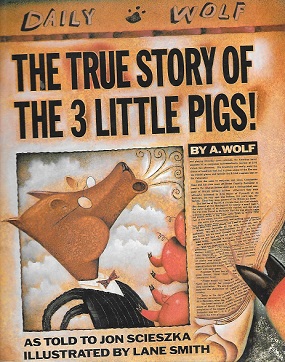
     I can picture it now; the burgundy carpet, black steel spinning racks filled with paperback books, and the carpeted audience seating that set the stage for our librarian. My initial reading and interest in story telling began in my elementary school, Cranberry Pines. I do not recall our librarians name, but I can remember her curly gray and white hair, the glasses that sat on the edge of her nose, and the long patterned skirts and sweaters that she would always wear. I remember her reading my favorite book when I was young, the story of the three little pigs told from the wolf's perspective.   
Image result for three little pigs real story

     I was fortunate enough to come from a great school district and a beautiful school. In our library we learned that silence was golden, how to gently turn a book's pages and how to find books using the dewy decimal system. I can recall sorting through the drawers and index cards, walking among the tall wooden shelves and glancing at the numbers and author's names on the spines of books in order to track down the correct one. The library planted the seed in my brain for both order and the wonder of different worlds that could be brought to life by printed words.
Image may contain: 5 people, people smiling, people sitting, child and shoes
Photo of my siblings and I before my youngest brother was born!  My oldest sister is holding me, we are very close still!

      At home my father was constantly reading, there would always be stacks of books in the den, his book shelf overflowing and spilling onto the floor of my parent's bedroom. I can remember the smell and the smoothness of the hardback books that were left uncovered stripped of their book sleeves. I don't really remember my parents reading books to me but I do recall my older sister reading to me as a child. She always had an affection for literature from an early age, my interest in reading developed later in life. Now one of my favorite things to do in the summer is to read in my backyard in my hammock. I associate reading with being outdoors, whether it is in my backyard on a spring day, or with my toes enthralled by the sand at the beach. In the winter months I tend to read curled under my covers before I go to bed, so as the seasons change so do my reading rituals. I found that as I get older I appreciate the art of written word more and more.   

    I live in the same house I was raised in Medford, New Jersey, a small town about forty minutes from Philadelphia. I am one of five children, three boys and three girls, our family expands as the years go on, and I'm head over heels for the niece that is our newest addition to the family.  During the week I work as a substitute teacher in the town next to mine, Marlton, and on the weekends I work in retail. This is the first class that I am taking at NJCU, to start my graduate degree in Elementary Education. I am excited to begin this journey as a teacher, I would love to have a job in a kindergarten class but will embrace where life takes me in my developing career. I am intrigued about the storybook assignment specifically in this course I have been writing poems since I was young.  I can still remember the notebook I first wrote in, with a kitten and puppy on the purple front cover.  I am grateful to continue my education and look forward growing intellectually over the next few years at NJCU.